
Bye, America.
The "Sell America" trade redux.

An across-the-board selloff in US assets on Tuesday (the dollar, stocks and bonds all sinking in unison) uncannily resembled the turmoil sparked by President Donald Trump’s blanket tariffs last year. On several occasions from March through August, these three asset classes repeatedly slid together, fueling speculation of a global rotation out of American holdings. The reality was more nuanced (shifting hedging strategies also played a role in the dollar’s weakness), but investors worldwide clearly began to question the sanctity of their US exposures.
The “Sell America” trade was born.
Those same concerns are again in force. Trump’s latest trade broadside, threatening tariffs on eight European allies over the Greenland dispute, has rattled markets. The Bloomberg dollar index is down roughly 0.5% on the session, its second straight drop, as traders digest headline risks from Davos and an unprecedented feud over Danish territory. The S&P 500 sank about 2% for its worst day since October, and even US Treasuries sold off, lifting yields across the curve to multi-month highs. It’s a highly unusual trifecta. Typically, when Wall Street plunges, the dollar strengthens on safe-haven demand, and Treasuries rally with inflows. Equities and the greenback usually sport a negative correlation. Indeed, episodes of so-called “American exceptionalism” (when stocks, the dollar and bonds all rise together) are rare, and the reverse scenario is just as uncommon. That inverse relationship broke down early last year during Trump’s tariff tantrums, before normalising by autumn.
Now the question is whether we’ll see another temporary positive correlation shock, with the dollar trading in line with equities and other risk assets, in the days ahead if foreign holders truly start to “sell America.”
Or as I like to coin this latest chapter: “Bye, America.”
Greenland, the world’s largest island, has improbably become the centre of a transatlantic tussle, something I have written about here and here. Trump’s insistence on purchasing Greenland (an autonomous Danish territory) and Europe’s firm refusal have escalated into a serious rift. Europe has relatively few effective levers against Trump’s America, but the US stock market remains a point of potential vulnerability.
Enter the “Greenland 8.” This cohort—Denmark, Finland, France, Germany, the Netherlands, Norway, Sweden and the UK—are the NATO allies now in Trump’s crosshairs. Collectively, they also happen to be enormous investors in US assets. Their holdings aren’t concentrated in any single fund (Norway’s giant oil pension fund is likely the biggest individual player), but together they have been major buyers of American equities in recent years. In fact, monthly net purchases of US stocks by these countries hit record highs over the past year, according to US Treasury data. Were that inflow to suddenly reverse into an outflow, it would leave a mark on markets.
The irony is that many of the Greenland 8 are rubbing shoulders in Davos this week. One can imagine the muttered conversations over coffee (or perhaps peppermint schnapps) among representatives of those eight European nations threatened with tariffs for supporting Denmark’s refusal to sell territory.
In Hollywood, the bullied kid eventually fights back. But in international relations, hitting back isn’t always so simple, and the tools at Europe’s disposal each have drawbacks.
Europe’s potential responses basically fall into three buckets:
Tit-for-tat tariffs on US goods: This would be talking to Trump in the language he understands. EU leaders are reportedly discussing €93 billion in retaliatory duties as a “big bazooka” response. The problem? A full-blown trade war over Greenland would be a lose-lose, further hurting growth on both sides.
Tax or regulate US tech and corporations: Europe could try to hit corporate America’s pocketbook, for example, through digital service taxes or stricter regulation of US multinationals. In theory, this targets some of the biggest beneficiaries of globalisation. In practice, it’s hard to get all EU members on board. Ireland, for one, has little incentive to play along when it hosts so many US tech giants.
The financial “nuclear option”—selling or freezing purchases of US assets. This idea has been trotted out in geopolitical spats for decades. It first appeared in the 1970s as a rumoured adjunct to the OPEC oil embargo. China has often been discussed as a candidate, though while China’s official Treasury holdings have dipped in recent years, “Belgian” holdings mysteriously surged at the same time (suggesting some of Beijing’s money is parked at Euroclear in Belgium). And of course, Russia actually did dump nearly all its US Treasury bonds in 2018 amid sanction fears, slashing its stake from $96 billion to just $15 billion in the span of two months.
So here we are again, with that old chestnut of “Bye, America” being polished up as a potential weapon. The notion that foreign creditors might destabilise US markets by offloading holdings has always loomed in the background, usually as a thought experiment, rarely as reality. Yet Trump’s Greenland gambit has breathed new life into the idea. The eight countries directly targeted by his tariff ultimatum collectively own roughly $8.5 trillion in US stocks, bonds and other assets. Analysts at Deutsche Bank note that Europe is by far the United States’ largest foreign creditor, holding almost twice as many US assets as the rest of the world combined. Even selling a fraction of that immense portfolio, or simply choosing not to reinvest as securities mature, could be felt across US financial markets.
Interestingly, during last year’s tariff tantrum, there was plenty of speculation that Europe or others might hit the sell button on US assets, yet there’s no evidence anyone actually did. Quite the opposite. Collectively, these nations bought about $240 billion of US securities from February through May of last year, acting as stabilising buyers rather than dumpers.
Maybe the second innings creates a shift. We’ve already seen one symbolic shot across the bow. A Danish pension fund announced it will liquidate its entire $100 million holding of US Treasuries, citing concerns about poor US fiscal trends, while pointedly noting the Greenland row “didn’t make it harder” to decide.
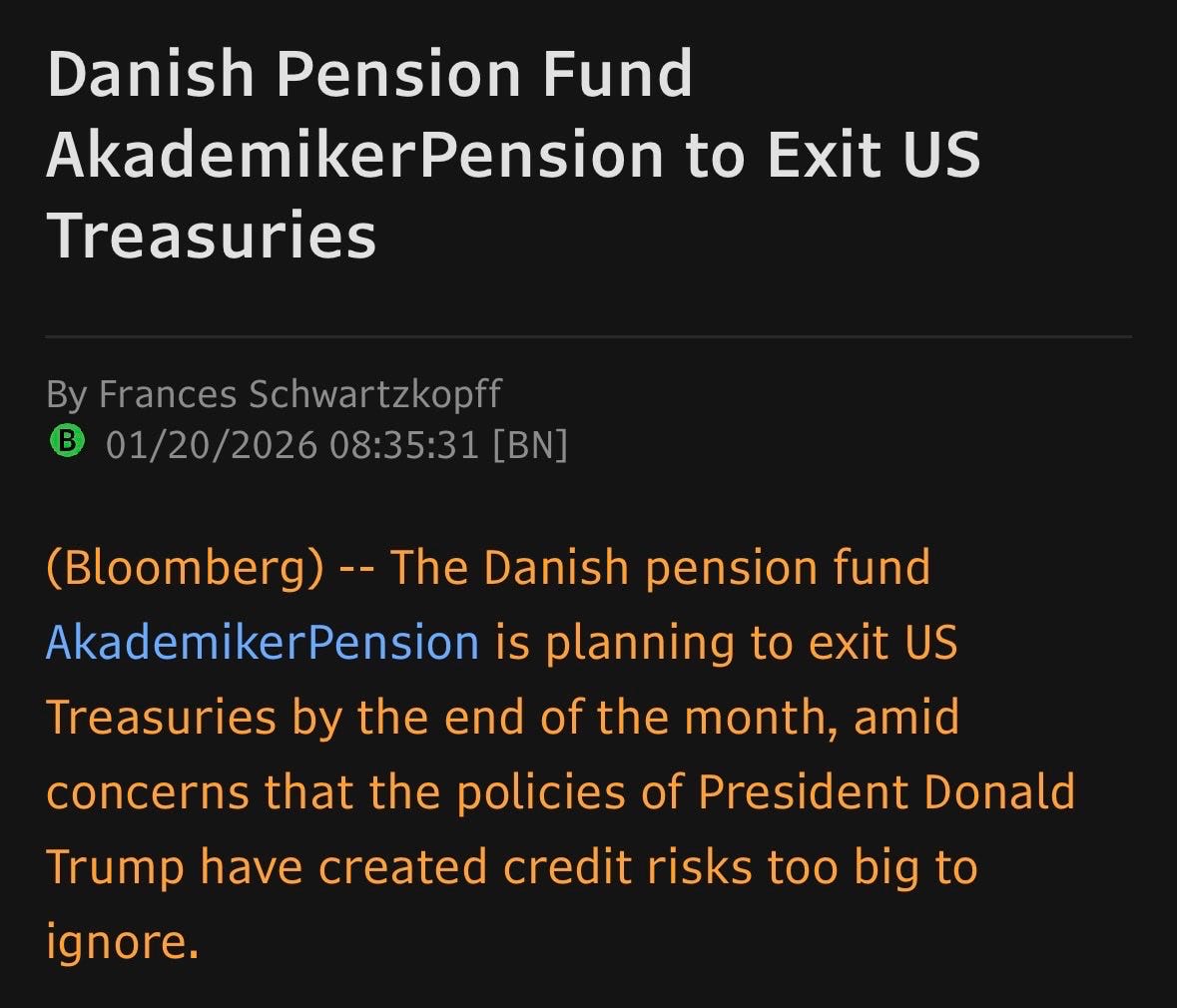
Don’t get me wrong… $100 million is a drop in the bucket of the $25 trillion Treasury market, but the move’s timing speaks volumes. And it underscores a key point: Europe’s institutions don’t even have to sell American assets to make an impact. Simply shifting from “buy America” to “bye, America” (halting their steady purchases) would create a noticeable demand shortfall. If European pensions, insurers and central banks stop ploughing money into US stocks and bonds at the recent pace, prices may need to adjust downward to entice other buyers to fill the gap.
Will major European institutions truly wield the financial nuclear option and start unloading US assets? Probably not in any dramatic fashion. Such a step would hurt their own portfolios equally. But even if they refrain from a full-on punch, simply pulling their punches could still deliver a sting. The very fact that “Sell America” is back in its new form means global markets will be watching these correlations and capital flows nervously.
Time for my coffee,
J

Exceptional breakdown of how trade policy creates unintended correlations across asset classes. The observation that typical safe-haven dynamics get inverted during thesepolitical flashpoints really clarifies why positioning becomes so treacherous. I remember last year's tariff volatilty where hedges suddenly became exposures. That Danish pension fund move is symbolic but it flags how quickly sentiment can shift when buyers just step aside.