
The Last Mile
How tariffs bent core inflation and reshaped the Fed’s 2026 outlook.

Early last year, President Donald Trump rolled out the highest US tariff rates in more than a century, promising they would boost government revenue and leverage in negotiations, with no effect on inflation and no real collateral damage. After a dizzying sequence of changes, many of them implemented via social media decree, US import duties are now, by most measures, at their highest level in roughly eight decades. We now have the data to judge that experiment.
It didn’t cause a recession. It didn’t trigger an inflation spiral. But it wasn’t without pain.
Tariffs have squeezed household budgets, raised borrowing costs, and complicated the Fed’s path back to “normal” (exactly what that level is may be up for debate). And for Americans still trying to recover from the 2021–2023 cost-of-living shock, tariffs delayed the healing process. Mercifully, the inflation impact now appears to be peaking.
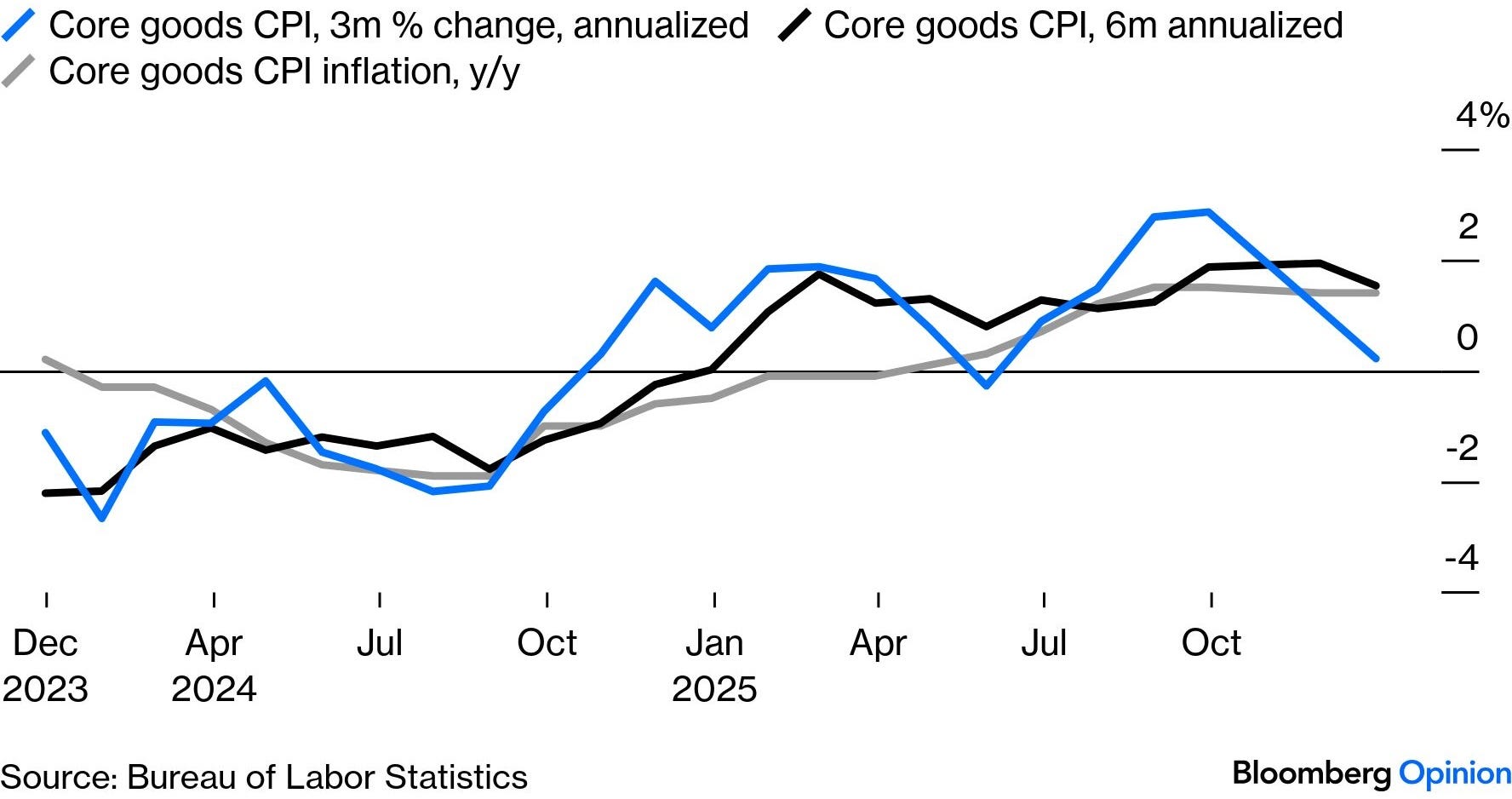
The cleanest place to see this is in core goods inflation, the part of CPI most directly exposed to tariffs. On a three-month annualised basis, core goods are now clearly cooling, after igniting almost immediately when Trump assumed office, accelerating after the April 2 Liberation Day tariffs, and peaking around September at roughly 1.5% year-over-year. At the height of the tariff impulse, goods alone were contributing close to 30 basis points to headline CPI. New York Fed President John Williams has estimated the true tariff effect was likely larger, closer to half a percentage point. In other words, December’s 2.7% CPI inflation probably would have printed closer to 2.2–2.4% in a counterfactual world without tariffs.
That half-point matters. Inflation-adjusted average hourly earnings grew about 1.1% in 2025. Fine, but hardly a breakout. It was the same real wage growth rate as in the final year of the Biden presidency. For lower-income households, the composition of the inflation shock was arguably more damaging than the headline number. The biggest tariff pass-throughs showed up in categories that dominate essential spending: children’s clothing, furniture and bedding, tools and outdoor equipment, and auto parts.
The good news is that the data are finally bending back. Headline CPI closed 2025 at 2.7%. Core CPI slipped to roughly 2.6% in December, the lowest reading since 2021. Goods disinflation has resumed. Shelter inflation is decelerating. The post-pandemic inflation machine is, slowly, grinding to a halt.
But the Fed does not target CPI. The real test is core PCE (don’t say the line, don’t say the line), and December’s number is not yet in hand. We get it later this month. Given the recent CPI prints and the continued cooling in goods and housing, December core PCE will almost certainly show further improvement. The direction is no longer in doubt, but the rate of change is.
So what for the rate path? The Fed spent most of 2025 in a defensive crouch because tariffs injected an artificial and politically unstable inflation impulse into an environment where inflation expectations were already bruised. Several policymakers were explicit about this risk. The concern was that they would convince households and businesses that inflation was structurally back, and that psychology would do the rest: if people expect higher prices, they spend more now and demand higher wages, while businesses raise prices to protect profits, creating a self-fulfilling cycle.
So the Fed chose caution. Before Trump’s election, economists surveyed by Bloomberg broadly expected the policy rate to be somewhere near 3.0–3.25% by now. Instead, it sits roughly half a percentage point higher. That difference can be argued as tariffs. The Fed may not have “hiked because of tariffs,” but it very clearly didn’t cut because of them.
This is why the inflation story of 2025 is inseparable from the rate story. And it is also why 2026 is shaping up not as a victory lap, but as a slow normalisation exercise. Even with inflation cooling, Fed officials are still signalling that policy will remain modestly restrictive until core PCE is convincingly back near 2% and expectations are unquestionably anchored. Most internal forecasts still don’t get there until late 2026 or 2027. That implies a shallower cutting cycle than markets were pricing a year ago.
The tariff episode also explains the strange divergence we’ve seen across corporate America. Large public companies largely absorbed the shock. They diversified suppliers, negotiated margins, lobbied aggressively, and passed through price increases where they could. The S&P 500 pushed back toward record highs. Small businesses, by contrast, took the hit. According to ADP, employment growth among firms with fewer than 50 workers has been flat or negative over the past year. Cost pressure and policy uncertainty mattered more at the margin than AI capex booms or stock market wealth effects.
Supporters of the administration point out, correctly, that the US avoided a recession and never saw a serious inflation resurgence. But that outcome had less to do with tariff design and more to do with the macro environment Trump inherited. The economy entered 2025 with strong nominal momentum, a massive private-sector AI investment cycle, and an inflation process that was already healing under the Fed’s patient policy stance. Very few economists ever had recession in their base case, almost none projected inflation sustainably back above 4%, and the eventual moderation of some tariff proposals mattered.
Which brings us back to today. Core CPI is cooling. Core goods inflation is fading. Core PCE is likely to follow. The tariff impulse is finally washing out of the year-over-year numbers. That should give the Fed room to move this year, but still at a slow pace.
Time for my coffee.
J
Interesting note. I like the way you’re thinking about this, but I’m curious — what’s your actual process look like when you’re working through these ideas?
Over at After the Close I focus a lot on how decisions are documented and why certain setups get attention while others don’t. I’d be glad to compare notes on that side of things if you ever want to share more about how you approach your process.