Mr Mac & Mrs Mae
“Don’t fight the GSEs” replaces “don’t fight the Fed.”

Fannie Mae and Freddie Mac have a way of reappearing in American finance just when everyone has decided they belong to history. Like estranged relatives who once wrecked a wedding and were quietly uninvited thereafter, they were meant to stay out of sight, kept alive, fed modestly, and never again trusted with the silverware. And yet here they are, back in the living room, moving furniture around.
In the last five months through October, the two government-sponsored enterprises (GSEs) have expanded their retained portfolios by more than 25%, lifting combined holdings to roughly $234 billion. That may sound modest by pre-2008 standards, when the twins were running a $1.5 trillion balance sheet hustle, but context matters. For most of the post-crisis era, the retained portfolio was treated as radioactive… capped, shrinking, and deliberately dull. It was policy scar tissue made visible.
Now the scar tissue is loosening.
The immediate effect is mechanical and familiar to anyone who trades mortgages for a living. When Fannie and Freddie retain more loans and agency MBS instead of pushing them out to the market, the free float shrinks. Less supply, firmer prices, tighter spreads. Citi estimates that another $100 billion of portfolio growth could compress MBS risk premia by roughly 25bps.
What makes this shift interesting is not just the rate impact, but the intent, or rather, the ambiguity of intent. Officials are saying very little, which is usually a sign that several objectives are being pursued at once. Lower mortgage rates are politically attractive, especially ahead of midterms. Housing affordability polls terribly. So does the idea of a “national housing emergency,” floated recently by the Treasury. If you want to nudge mortgage rates lower without asking the Federal Reserve to reverse its balance sheet runoff, directing the GSEs to step in is an elegant workaround. A shadow lever, pulled quietly.
But there is a second motive sitting just beneath the surface: optics.
Fannie and Freddie are, once again, being prepped for life outside conservatorship. Nearly seventeen years after the government absorbed them during the financial crisis, the idea of an IPO has moved from punchline to process. Bankers have been consulted. Commerce Secretary Lutnick has stated “sooner rather than later.” And anyone who has read even a portion of Michael Burry’s extended meditation on the twins’ past sins and present balance sheets will appreciate how much preparation remains before that curtain can be raised.
Here is where the retained portfolio matters. Guarantee fees are steady but unexciting. They look like a regulated utility business because, functionally, that is what they are. Retained portfolios, by contrast, generate visible net interest income. They make earnings charts slope upward. They tell a story investors can recognise. If you are trying to convince public-market buyers that Fannie and Freddie deserve a valuation multiple that reflects growth rather than penance, padding the portfolio is a straightforward way to do it.
This is also where history starts to whisper uncomfortably.
The retained portfolio was not some incidental side business in the 1990s and early 2000s. It was the profit engine. Borrow cheap, buy mortgages, lever gently until you are no longer gentle. When underwriting standards slipped, and private-label securities crept in, the model metastasised. By the time the music stopped, the portfolios were politically untouchable. Losses followed, then conservatorship, then a decade of forced atonement.
Today’s defenders will argue, with some justification, that this is different. Underwriting is tighter. Capital rules exist. The Enterprise Regulatory Capital Framework, for all its complexity, is designed explicitly to prevent a return to the old drunk-and-disorderly days. And even after this recent growth spurt, Fannie and Freddie remain hundreds of billions below their portfolio caps. No one is suggesting a return to trillion-dollar balance sheets anytime soon.
Still, markets have long memories, even when policymakers prefer amnesia.
The deeper implication of the current expansion is that Fannie and Freddie are once again becoming marginal buyers in the $9 trillion agency MBS market. Over the last three years, that role shifted awkwardly to money managers as the Fed stepped away. Volatility rose. Spreads widened episodically. The market learned to live without a buyer of last resort. If the GSEs now step back into that role, even partially, they will change how risk is priced. Volatility dampens not because risk disappears, but because someone with a very long balance sheet is willing to lean against it.
That has consequences. Investors begin to watch policy signals more closely than fundamentals. Spread widening becomes an invitation rather than a warning. “Don’t fight the GSEs” replaces “don’t fight the Fed.” It is a subtle shift, but a powerful one.
There is also a political tension embedded here. Portfolio growth that helps first-time buyers and flatters IPO math can, if unchecked, reignite debates about market distortion and moral hazard. The line between support and manipulation is thin, and Fannie and Freddie have crossed it before. No administration wants to be remembered as the one that let the twins relapse.
Which leaves us with the uncomfortable but fascinating takeaway. Fannie Mae and Freddie Mac are not just financial institutions, but instruments. They can be used to lower mortgage rates, to stabilise markets, to dress up earnings, and to stage-manage an exit from conservatorship. They can also, if history is any guide, quietly accumulate risk while everyone congratulates themselves on how much smarter they are this time.
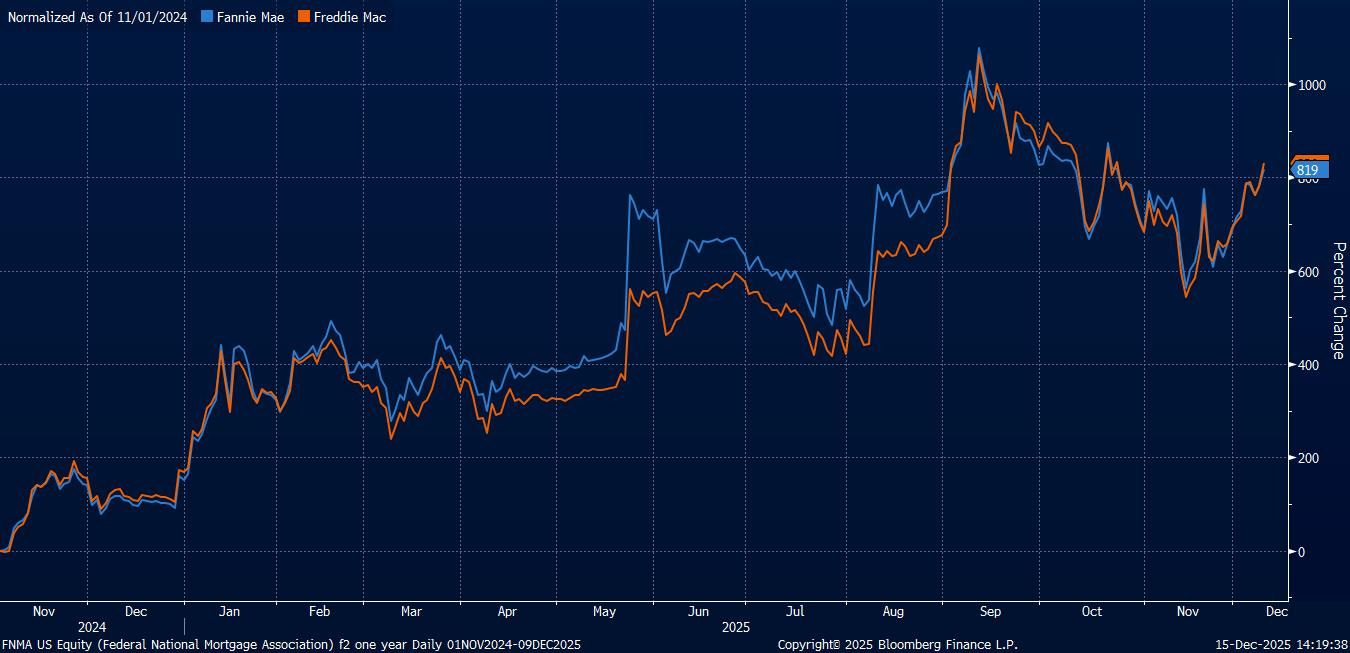
Mr Mac and Mrs Mae are back on their feet. They are well-dressed, politely spoken, and insist they have changed. Markets, as ever, are inclined to believe.
It was a busy old weekend, so apologies for no note hitting the inbox. But as I start my week off in the weeds, these thoughts were worth sharing.
Time for my (later than usual) coffee.
J