
Gate Crashing
Back from a hiatus.

Behind the chaos of the Middle East, a familiar character lingers just offstage. It was the opening act, and an uneasy one at that, before retreating from view as a louder, more urgent chapter of the play took hold. For now, it watches from the wings, waiting for its cue. But this is not a role that can be written out. The final act will demand its return.
That character is private credit and all its woes.
In recent months, the industry has been living with a sense of deferred reckoning. A series of high-profile blowups unsettled confidence. Questions lingered over concentrated exposure to software businesses, particularly those whose valuations are most vulnerable to the shifting economics of AI. Meanwhile, a client base that had been painstakingly assembled (including a growing cohort of retail investors) has started to behave rather less patiently than the asset class might prefer.
Private credit promises stability, yield and insulation from daily market noise. But it does so by holding assets that cannot easily be sold. That trade-off works well enough in calm conditions. It becomes more awkward when investors decide they would like their money back.
Earlier this month, BlackRock (BLK US) drew the line. “No redemptions above 5%,” after clients wanted to cash in about ten. For an industry now approaching $1.8 trillion in size (and still intent on expanding into retirement savings pools) the decision felt both necessary and faintly uncomfortable. It risks unsettling a class of investors not accustomed to being told to wait. But the alternative (meeting all redemptions in full) risks something worse: forced asset sales, impaired pricing, and a reallocation of losses toward those who remain.
These vehicles are designed with liquidity limits precisely because the underlying assets demand them. Matching the pace of inflows and outflows to the natural rhythm of the loans is a central feature. To ignore that discipline at the first sign of strain would be to undermine the entire premise. Yet BlackRock are not alone.
On Monday, Apollo Global Management (APO US) adopted a similar stance with a 5% cap, and others appear to be circling the same conclusion. The industry waits for a large player to move first — to provide cover, as much as leadership. That moment has now arrived.
However, the cap isn’t hard and fast. In recent months, a handful of managers1 have permitted redemptions above stated thresholds, while insisting that portfolio quality remains sound and returns robust. The intention is that the flexibility will help calm investor nerves. But the decision is fueling a debate over whether short-term optics are outweighing long-term discipline, ultimately favouring those investors who rush for the exit. Some industry executives dispute characterising the caps as “gates” because the threshold is embedded in the fund’s structure. Not holding the line, though, can weaken that argument.
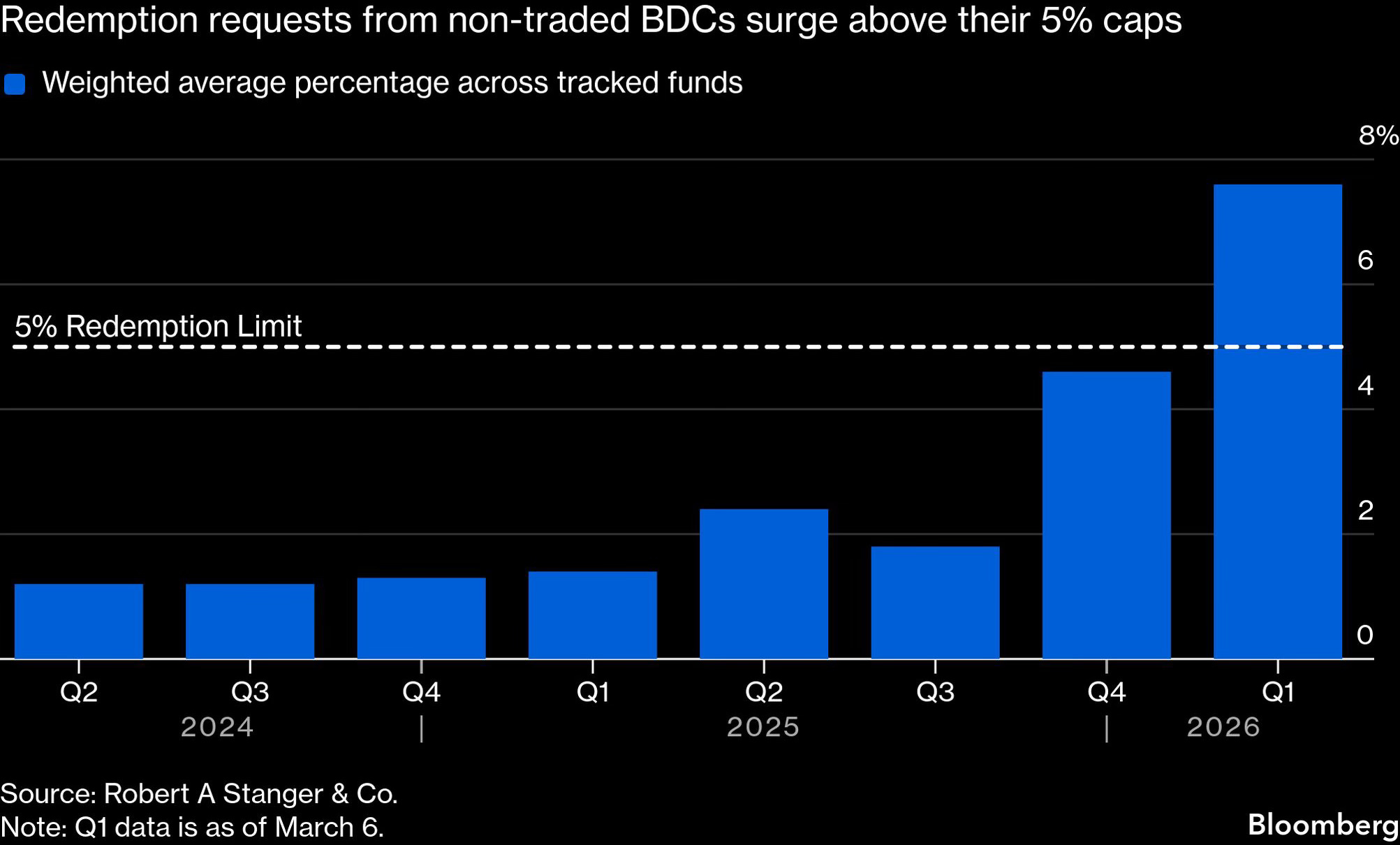
You cannot create liquidity from an illiquid asset class. Not enforcing withdrawal limits will create a first-mover advantage for early redeemers and a prisoner’s dilemma problem for the remaining investors. Letting money escape at a moment of market weakness is antithetical to the credo of many in private assets.
Markets may yet look through the current geopolitical turbulence. Oil shocks fade (eventually), risk assets stabilise, and the macro narrative moves on. But private credit presents a different kind of risk, one less visible and more reflexive. If redemption pressure builds and managers waver in enforcing limits, the system begins to test itself. What starts as a liquidity management exercise can become a confidence problem, and confidence, once questioned, tends to travel faster than the underlying fundamentals. The concern is not that private credit breaks overnight, but that it becomes the locus of the next period of financial stress — not because the assets are uniformly poor, but because the promise of liquidity was always more fragile than it appeared.
Time for my coffee (apologies for the hiatus),
J
Funds include Blue Owl Technology Income, which repurchased 15.4% of shares in the fourth quarter, as well as Ares Strategic Income Fund, North Haven Private Income Fund and Blue Owl Credit Income, which honoured 5.6%, 5.3% and 5.2% of redemptions, respectively.